 Flip through our history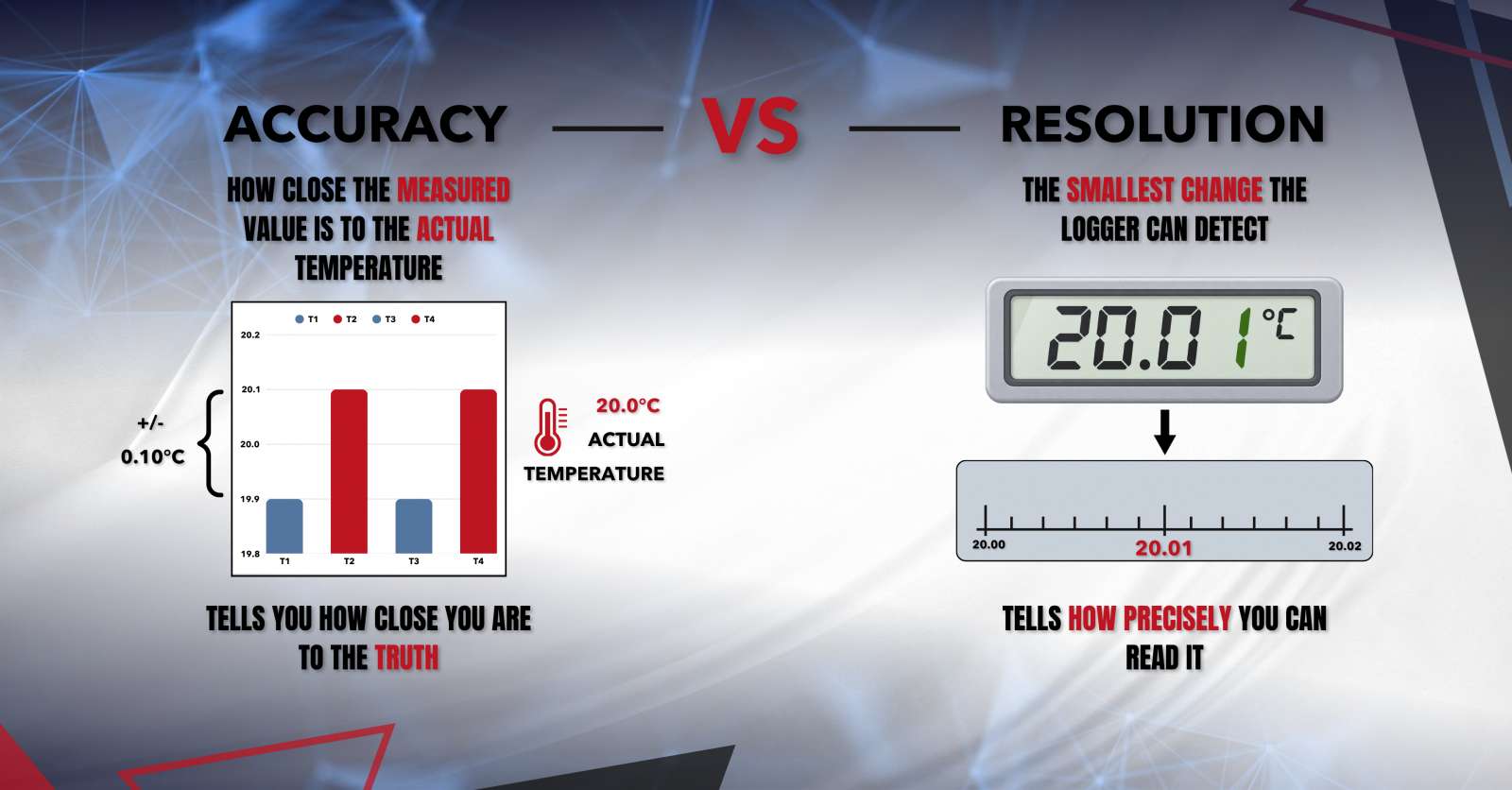
When choosing a temperature data logger, you may come across two specifications that sound similar but mean very different things:
- Resolution: how small a change the logger can detect. For example, a logger with a resolution of 0.01 °C can distinguish between measurements such as 20.00 °C and 20.01 °C.
- Accuracy: how close the measured value is to the actual temperature. If the actual temperature is 20.00°C and your logger measures 20.10 °C, the accuracy is ±0.10 °C.
So, does higher resolution mean higher accuracy? No! A logger can display temperature with two decimal places while still having relatively low accuracy.
Think of it this way:
- Resolution tells you how precisely you can read the measurement.
- Accuracy tells you how close that measurement is to reality.
That's why, when selecting a data logger, looking only at the number of decimal places isn't enough.
Tags
More news


What is measurement Uncertainty?
18/09/2026


Why does logger probe length matter?
04/09/2026